

Nobunaga
信長
"A masterful strategist and a ruthless daimyo who brought Japan to the edge of unification by way of swords and guns."
The Demon King
of the Sixth Heaven
第六天魔王
Oda Nobunaga was the first of Japan's three great unifiers — a visionary warlord who rose from the minor province of Owari to nearly unite all of Japan under a single banner. Born in 1534, he was known in his youth as 'The Fool of Owari' for his eccentric behavior, but his military genius would reshape the nation forever.
Nobunaga embraced innovation with a ferocity that terrified his contemporaries. He was among the first Japanese commanders to deploy firearms en masse, shattering the cavalry charges of the Takeda clan at the Battle of Nagashino in 1575. He built Azuchi Castle — a towering symbol of power unlike anything Japan had seen — and systematically dismantled the political influence of the Buddhist warrior monks who had held sway for centuries.
His enemies called him the 'Demon King of the Sixth Heaven' — Dairokuten Maō — a title from Buddhist cosmology referring to a being who delights in the suffering of others. Nobunaga reportedly embraced the name, understanding that fear was as powerful a weapon as any sword or musket. Yet he was also a patron of the arts, a lover of Noh theater, and a man who welcomed foreign traders and missionaries when others would have turned them away.
On June 21, 1582, at the Honnō-ji temple in Kyoto, Nobunaga was betrayed by his vassal Akechi Mitsuhide. Surrounded by overwhelming forces, he committed seppuku rather than face capture. The temple burned around him, and his body was never recovered. The Honnō-ji Incident remains one of the most dramatic moments in Japanese history — the Demon King consumed by flames, his dream of unification left for his successors Toyotomi Hideyoshi and Tokugawa Ieyasu to complete.
"If a bird does not sing, I will kill it. If a bird does not sing, I will make it want to sing. If a bird does not sing, I will wait for it to sing." — The three unifiers of Japan, with Nobunaga as the first.
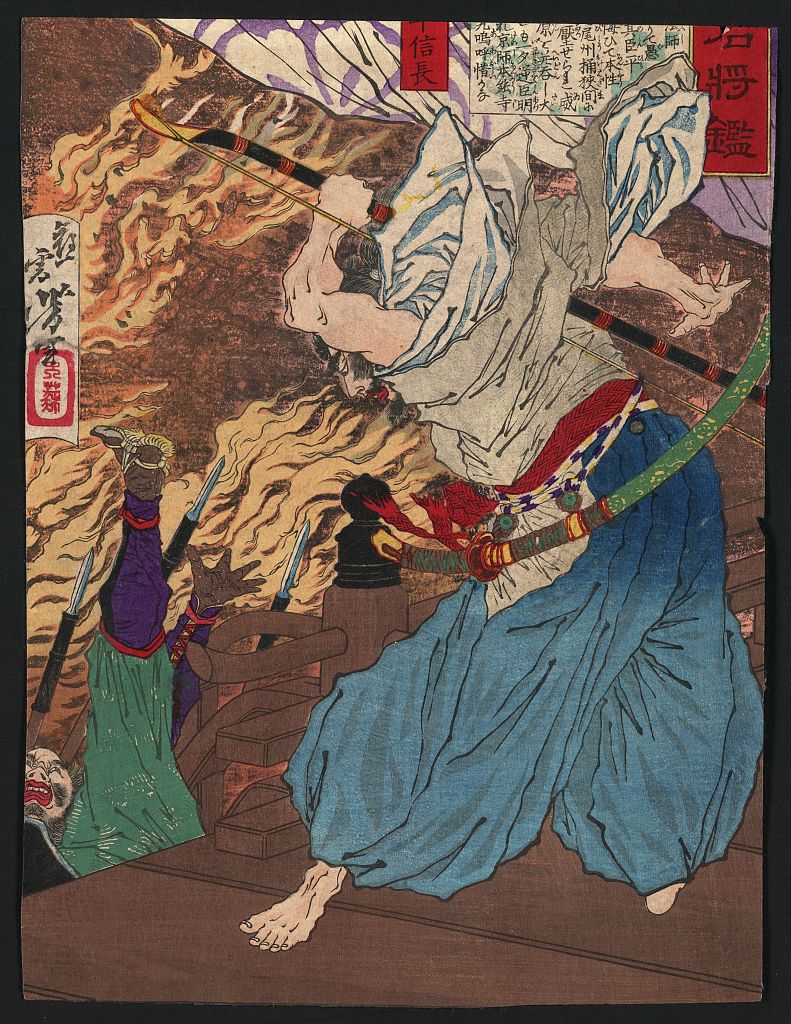
Yoshitoshi — Nobunaga at Honnō-ji, c. 1880
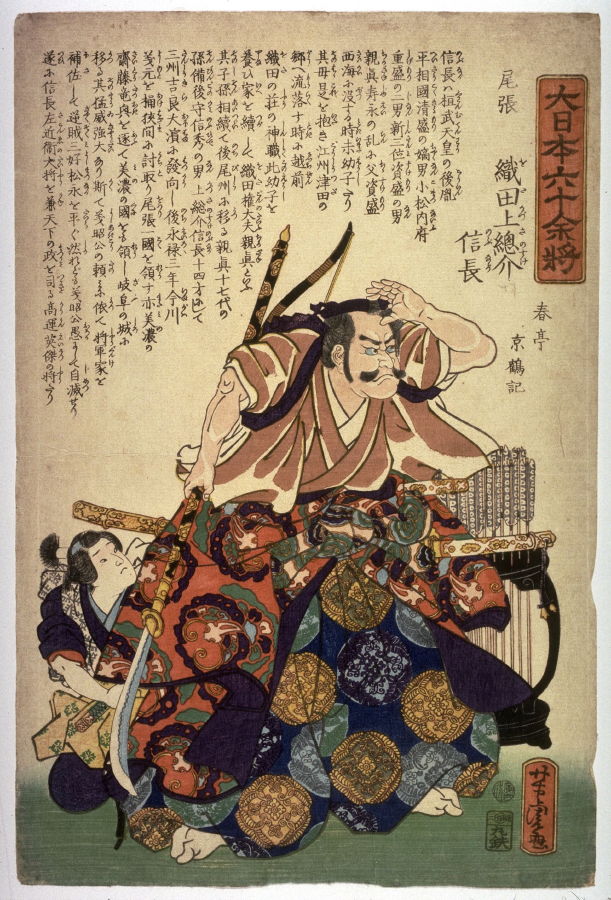
Utagawa — Oda Nobunaga of Owari Province
The Artist's Vision
Shogun Series — Label Design
For the inaugural Shogun Series expression, the artist shifted approach from the supernatural realm of the Yokai to the historical intensity of Japan's most fearsome warlord. The research centered on the duality of Nobunaga — the cultured aesthete who patronized the arts and the ruthless strategist who burned temples and slaughtered thousands.
The illustration captures Nobunaga in full battle regalia, katana drawn, robes billowing with the force of his forward momentum. Unlike the Yokai illustrations which channel mythological energy, this composition channels raw human ambition — the determination of a man who would reshape an entire nation or die trying.
The crimson circle behind the figure serves a different purpose here than in the Yokai series. For the Tengu, it references the sacred; for Nobunaga, it evokes the burning of Honnō-ji — the flames that consumed the Demon King at the moment of his greatest vulnerability. It is simultaneously a rising sun and a funeral pyre.
Research & Immersion
Deep study of historical references and folklore texts
Composition & Ink
Translating mythology into dynamic visual composition
Final Illustration
Final hand-inked artwork for the label
"Nobunaga demanded a different energy — not supernatural like the Yokai, but human ambition pushed to its absolute limit. The red sun behind him is both rising and setting."
On the Nobunaga Illustration

From Ambition to Barrel
The Nobunaga expression represents the bold, innovative spirit of the Shogun Series — a 15-year-old Kentucky straight bourbon finished in ex-Japanese whisky casks from the city of Chichibu. It is a liquid that bridges two worlds, just as Nobunaga himself bridged the medieval and modern eras of Japan.
The Chichibu finish adds layers of complexity that echo Nobunaga's own multifaceted nature — delicate Japanese oak influence over a foundation of robust American bourbon. The result is a whiskey that refuses to be categorized, much like the man who inspired it.
At 122 proof, the Nobunaga expression carries the full weight of its fifteen years without apology or dilution. It is barrel proof in the truest sense — uncompromising, unapologetic, and impossible to ignore. A love letter from Kentucky to Japan, written in oak and fire.
"This bottle reflects the bold and innovative nature of Nobunaga — taking 15-year-old Kentucky straight bourbon and finishing it in ex-Japanese whisky casks from the city of Chichibu in Japan."

Mugen Spirit
Infinite Spirit. Boundless Craft.